
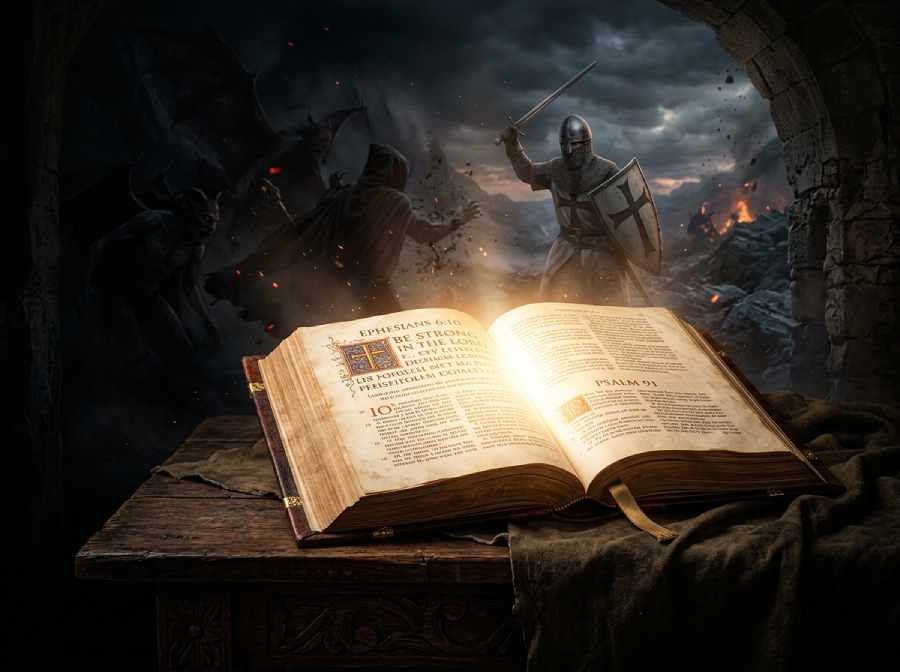
These eight biblical facts about evil spirits matter because myths, folklore, and popular media have shaped how many people imagine them. Scripture, however, presents evil spirits as real spiritual beings who rebel against God—not as the exaggerated creatures that art and entertainment often portray.
The Bible describes demons as evil spirits that can influence human behavior. By contrast, popular imagery often gives them tails, reddish-brown skin, horns, and other grotesque features. Art and media commonly use these details, but the Bible does not support them.
Therefore, I base my understanding of evil spirits on spiritual teachings, not on movies or folklore.
Mythology has shaped a familiar image of the devil: a horned figure who carries a pitchfork, rules a fiery underworld, and torments people who lived wicked lives. Yet Scripture never describes him this way. So, what do these biblical facts about evil spirits actually reveal?
The Origin of Evil Spirits

Did God Create Demons?
The first of these biblical facts about evil spirits begins with creation. The Bible says that, in the beginning, God created the heavens and the earth (Genesis 1:1). The heavens include galaxies, stars, solar systems, and planets.
God also created spirit beings to establish His kingdom and government throughout the universe. He called these beings angels (Psalm 104:4).
Angels are intelligent beings who serve God. They can choose obedience or rebellion (Psalm 103:20; 2 Peter 2:4; Jude 6).
When God created all things, He called them very good (Genesis 1:31; Colossians 1:16). Angels reflect God’s power and glory. They worship Him and carry out His commands (Psalm 103:20-21; Revelation 5:11-12). Their service shows devotion to their Creator and delight in the work God gives them (Psalm 103:20-21).
Everything God created, including the angelic realm, was good (Genesis 1:31; Colossians 1:16). Christian tradition often connects the proud figures in Ezekiel 28:12-17 and Isaiah 14:12-15 with Satan’s fall. However, those passages directly address earthly rulers. Scripture identifies the Son of God as the eternal Word through whom all things were made (John 1:1-3).
Revelation portrays the dragon, identified as Satan, drawing a third of the stars and leading angels in war against God (Revelation 12:4, 7-9). This symbolic imagery is commonly understood as a rebellion involving fallen angels. These angels sinned and abandoned their proper place (2 Peter 2:4; Jude 6). Their rebellion clarifies Scripture’s account of their nature and work.
8 Biblical Facts About Evil Spirits

1. Evil Spirits Have Supernatural Power
The rebellion described above sparked war in heaven (Revelation 12:7-10). Lucifer and his followers fought the archangel Michael and his holy angels, but Michael’s forces defeated them and cast them out of heaven. These rebellious angels became known as evil spirits or demons, and their leader, Lucifer, became known as Satan, the devil.
Furthermore, evil spirits seek to destroy and enslave (John 8:44; John 10:10). In the Gospels, they drive destructive behavior and cause particular cases of blindness, seizures, and an inability to speak or hear (Matthew 9:32-33; Matthew 12:22; Mark 9:17-27). Scripture does not blame every illness on demons, but it does describe cases in which an unclean spirit controls a person.
For example, a legion of evil spirits possessed the Gadarene man. They drove him to live wildly among the tombs and gave him extraordinary strength (Mark 5:1-20).
2. Demons Serve Satan
Their supernatural power does not make evil spirits independent. Scripture shows Satan ruling a kingdom that opposes God (Matthew 12:24-26; Ephesians 2:2). Evil spirits serve Satan, the prince of darkness and humanity’s enemy (Revelation 12:9).
Christian tradition reads Ezekiel 28:12-17 and Isaiah 14:12-15 as reflections of Satan’s beauty, wisdom, pride, and fall. Yet the passages directly address the kings of Tyre and Babylon. Revelation symbolically shows the dragon sweeping a third of the stars from heaven. It later identifies him as Satan, whose angels fall with him to earth (Revelation 12:4, 7-9).
Satan means “adversary.” He is God’s enemy. The term “devil” means “accuser.” He accuses God’s people day and night before God’s throne (Revelation 12:7-11).
In Matthew 4:3, he is called the “tempter.” In John 8:44, he is a “murderer” and a “liar.” He is compared to a “lion” in 1 Peter 5:8 and a “serpent” in Genesis 3:1 and Revelation 12:9. Second Corinthians 11:13-15 calls him an “angel of light.” Second Corinthians 4:4 calls him the “god of this age.”
3. Demons Use Deception
Understanding Satan’s character helps explain the chief method he and his followers use: deception. Satan and his evil spirits can disguise themselves as angels of light. This disguise helps them appear good even when they intend evil (2 Corinthians 11:13-15).
Among the eight biblical facts about evil spirits, deception stands as their primary tool. Through subtle lies, they introduce ideas that contradict the gospel (Galatians 1:8-9; 1 Timothy 4:1). Believers may then accept teachings that stray from biblical truth. In this way, deception produces false doctrine.
These false teachings distort the gospel and undermine the foundation of faith (Galatians 1:6-9). Some claim that salvation can be earned through good works alone. This contradicts the biblical message of grace (Ephesians 2:8-9; Titus 3:5).
Other teachings suggest that there are multiple paths to God. This conflicts with Jesus’ claim in John 14:6 and the apostolic witness in Acts 4:12. By promoting these false doctrines, demons try to lure people away from God and the truth of Scripture (1 Timothy 4:1).
4. Evil Spirits Influence Earthly Powers
These biblical facts also show that deception can affect more than individual beliefs. Scripture describes spiritual conflict influencing earthly powers. Daniel 10:12-21 gives a vivid account of angelic conflict.
God sent an angelic messenger to Daniel. But the “prince of Persia,” a powerful spiritual being opposed to God’s purposes, delayed him for twenty-one days. The archangel Michael intervened and enabled the messenger to reach Daniel.
The account reveals spiritual battles unfolding behind the scenes. It also shows spiritual forces contending for influence over nations and their affairs.
This ancient narrative illustrates that spiritual conflict can stand behind events in the human realm. It also highlights that unseen forces are at work in the physical world. Therefore, our deepest struggle is not merely against other people, but against spiritual forces in high places of authority. Scripture says,
In other words, Ephesians 6:12 reminds us that our real struggle is not simply with other people. We are facing unseen spiritual forces—evil rulers, powers of darkness, and wicked spirits that work against God’s purposes in the spiritual realm (Ephesians 6:12 TLB).
Moreover, an evil spirit’s goal is to trouble God’s people and encourage patterns opposed to the Spirit, including pride, envy, strife, and malice (James 3:14-16; Galatians 5:19-21). This can manifest in discord within churches, jealousy among individuals, or selfishness and conflict in relationships. These effects bring the discussion from the unseen realm into everyday Christian life.
How This Spiritual Conflict Affects Us

5. Evil Spirits Are Also Called Unclean Spirits
Because this spiritual conflict reaches daily life, believers must understand how Scripture describes these beings. Some people question the existence of evil spirits, but Christianity affirms their reality. The Bible portrays these unclean spirits as enemies of all that God stands for.
God is holy, righteous, and good (Isaiah 45:21). Grace, mercy, and love are central to His character. Evil spirits hate these qualities because they reflect God’s righteousness and expose deception (2 Corinthians 11:13-15; John 8:44). They oppose the transforming power of God’s love by promoting division, pride, and malice.
6. Evil Spirits Spread Lies
One way unclean spirits oppose God’s character is by spreading lies. Lying evil spirits encourage delusion and error, leading people away from the truth of God’s word. According to 1 Kings 22:22-23, God permitted a lying spirit to influence the prophets of Israel. This passage describes how the spirit was sent to persuade King Ahab’s prophets to give him false hope, resulting in Ahab’s disaster in battle.
Satan stands behind lying and spiritual deception. Jesus calls him a liar and the father of lies (John 8:44), while Revelation identifies him as the deceiver of the whole world (Revelation 12:9). His influence reverses moral truth by calling evil good and good evil (Isaiah 5:20). His purposes are destructive, seeking to steal, kill, and destroy (John 10:10).
God is the source of truth, while the devil blinds minds to the gospel (2 Corinthians 4:4) and remains the enemy of truth. Through a lie, he brought spiritual and physical death to humankind (Genesis 3:4,13; 1 John 3:8,10-15). Satan is still distorting the truth, for he has no truth in him. He is a liar and only seeks to lead people away from God.
7. Evil Spirits Promote Deception
The lies described in Scripture can grow into organized teachings that draw people away from the faith. Scripture warns that, in the last days, some people will depart from the faith by listening to deceiving spirits and doctrines of demons and by speaking lies in hypocrisy.
Paul’s warning in 1 Timothy 4:1-2 calls believers to test teachings carefully and remain anchored in God’s truth. Prayer and regular study of Scripture help believers recognize spiritual deception before it shapes their beliefs.
8. Christ Defeated Evil Spirits and Darkness
Yet Scripture does not end its teaching with warnings about deception. While evil spirits are our enemies, they have been decisively defeated by Christ. Through the cross, Christ disarmed the rulers and authorities and triumphed over them (Colossians 2:15; Hebrews 2:14).
Through the cross, Christ stripped the rulers and powers of their authority, openly exposed their defeat, and triumphed over them (Colossians 2:15).
Jesus bore sin and fulfilled the Law’s righteous purpose through His obedient life and sacrificial death (Matthew 5:17; Romans 8:3-4; 1 Peter 2:24). At first, the powers of darkness appeared to have won. But on Resurrection Sunday, Jesus rose from the grave (1 Corinthians 15:3-4).
Through His death and resurrection, Christ broke the devil’s power over death (Hebrews 2:14-15). He also exposed the defeat of hostile spiritual powers (Colossians 2:15).
Through His death, resurrection, and ascension, Christ vindicated God. He secured victory over the devil (Acts 2:32-36; 1 John 3:8).
Living in Christ’s Victory
Christ’s victory is not merely a past event; it defines how believers can live today. The Holy Spirit lives within us (Romans 8:9-11; 1 Corinthians 6:19), giving us strength to resist deception, stand firm in truth, and fight the good fight of faith with endurance (Ephesians 6:13-18; 1 Timothy 6:12). We do not face darkness as defeated people. We stand in the triumph of Jesus Christ, trusting His authority and walking by faith (Romans 8:37; 2 Corinthians 5:7).
Let these eight biblical facts about evil spirits replace fear and folklore with biblical truth. Know the enemy’s methods, test every teaching against Scripture, and refuse to be intimidated by a foe Christ has already conquered. Darkness is real, but it does not have the final word. Jesus does—and in Him, believers can live with discernment, courage, confidence, and hope.
The cross settled the outcome: darkness may resist, but it cannot reign where Christ is Lord.
Discover more from BELIEVING FAITH
Subscribe to get the latest posts sent to your email.
