
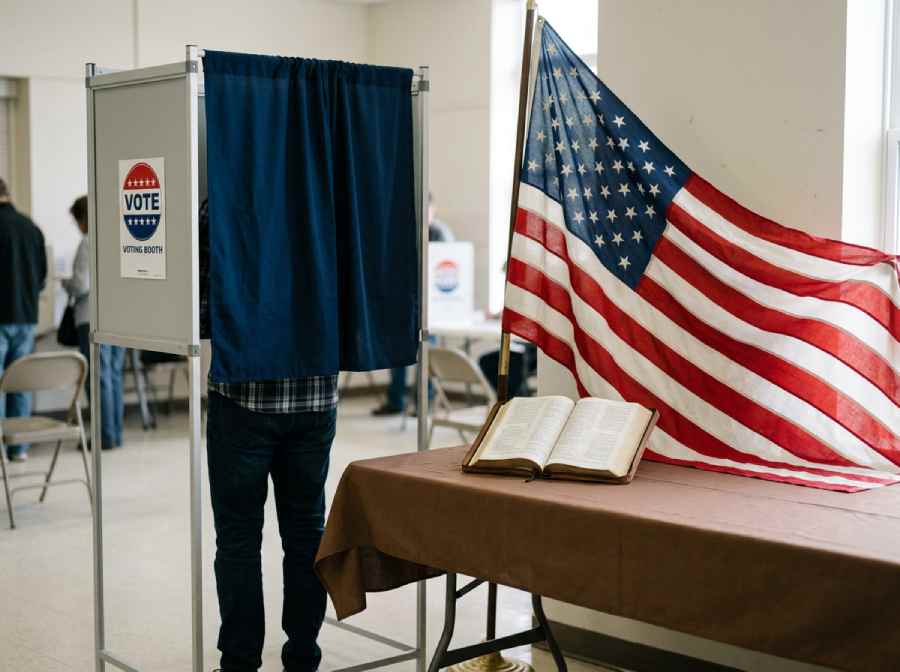
Faith and politics have long shaped public life in America, and Christian voters often face difficult choices when civic responsibility and biblical values seem to collide. This post reflects on leadership, constitutional rights, moral responsibility, and unity through the lens of faith and voting. At its core, it is a reflection on faith and politics in America.
Voting is rarely simple for people of faith. Questions about leadership, justice, religious freedom, and social issues continue to challenge voters who want their political choices to reflect their beliefs. In that tension, Christianity and politics remain a difficult but important conversation.
Any house, team, company, or nation can only be as productive as its leader. The leader shapes how followers respond to authority and adversity. In times of public uncertainty, leadership reveals whether it is grounded in humility, responsibility, and care for others. As a Christian, I have chosen to stand on values that reflect compassion, truth, and accountability.
Whether Democrat or Republican, black or white, rich or poor, Americans continue to wrestle with deep division in public life. Even so, people of faith are called to pursue unity, humility, and a better way forward.
Faith and Public Life in America
Many Americans identify as Christians, but Christianity is more than a label. It is a way of life rooted in Christ-like character. In a time of political division, believers must ask whether their public choices reflect the example of Jesus.
Jesus asked His disciples, “Who do people say that I am?” After they answered, He asked, “But who do you say that I am?” In the same way, many people form opinions about Christ and Christianity from the voices around them. But faith becomes clearer and more meaningful when it is personal, thoughtful, and lived out with conviction.
How Faith Shapes Political Attitudes
I am of African descent and was born in America. I honor my ancestry, and I am also proud to be an American. The Constitution begins with the words “We the People,” yet history reminds us that not everyone was included equally from the start. The Bible states that Christ gave His life for all people (John 3:16). America has made progress, but the work of justice and equality is not finished.
If we are true to ourselves, we will see that we are a divided nation of Christians. The Bible says: “Every kingdom divided against itself is brought to desolation, and every city or house divided against itself will not stand” (Matthew 12:25). So, I ask, “How will a Christian nation stand without first standing on Christianity’s Constitution—the Bible?”
Voting, Rights, and Moral Responsibility
I am in favor of pro-choice, and I agree that the unborn have rights that we should protect. But that unborn child may someday become an adult black man. If it is unlawful to abort an unborn baby, shouldn’t it be illegal to take the life of that baby when he has become a man? All life is precious.
Context matters. Imagine a single mother with three young children who becomes pregnant through rape, and the pregnancy threatens her life because of serious medical complications. If the pregnancy continues, she may die and leave her children without their mother. In cases like this, I believe the mother should have a meaningful voice in the decision, rather than having the outcome determined entirely by lawmakers far removed from her circumstances.
So, what does it mean to take a stance on pro-life and pro-choice? Definitions matter. Depending on who you ask, the terms pro-life and pro-choice each have their own distinct and prejudiced meanings.
Faith and Voting on Pro-Life Issues
The anti-abortion movement of the 1970s gave birth to our current pro-life movement. Interestingly, the term pro-life stems from the belief in the right to life, which states that a human being has the right to live and should, therefore, not be killed by another entity, including the government. Whether life is a premature baby, a newborn baby, a disabled person, or a senior, the sentiment is the same. All human life is equal; therefore, all life matters, not just unborn lives.
Faith and Voting on Pro-Choice Issues
Pro-choice is the belief that every woman should have the right to her own life and body. Therefore, denying a woman an abortion is denying her the right to make decisions concerning her bodily autonomy.
Religion, Rights, and Public Life in America
The Bill of Rights is the first of the ten Amendments to the United States Constitution. It guarantees civil rights and liberties to American citizens, including the right to prevent the government from creating or favoring a religion. These protections continue to shape debates about faith and politics in America.
Free Choice and Moral Responsibility
Pro-life and pro-choice are important issues to me, but as a Christian I also believe God grants human beings the freedom to choose. According to the Bible, sin entered the world through the disobedience of the first man, Adam. God gave Adam one command: “Of every tree of the garden you may freely eat, but of the tree of knowledge of good and evil you shall not eat” (Genesis 2:16-17). He could have forced obedience or placed obstacles in Adam’s way, but instead He gave a command and allowed Adam to choose.
I believe God’s word is true and authoritative. My question to fellow Christians is this: If God allows people to choose their path, why do we so often try to force obedience through law, as though God needs our protection? In the name of Christianity, why do some believe they must legislate against the choices of others? As believers, we are called to love people and leave ultimate judgment to God.
Love Without Condemnation
America is a nation of diverse ethnicities and religions. Christianity is only one of many religions practiced by Americans. Our part as Christians is to love, not to condemn. When we judge people, we not only blame them but also ourselves. God desires that Christians warn people of impending judgment. Nowhere in the Bible does God command us to force people to obey His commands.
“When I say to the wicked, ‘You shall surely die,’ and you give him no warning, nor speak to warn the wicked from his wicked way, to save his life, that same wicked man shall die in his iniquity; but his blood I will require at your hand. Yet, if you warn the wicked, and he does not turn from his wickedness, nor from his wicked way, he shall die in his iniquity, but you have delivered your soul.”
— Ezekiel 3:18-19
Leadership, Faith, and Voting in America
People of faith often look for leaders who demonstrate honesty, empathy, accountability, and wisdom. When leaders avoid responsibility, deepen division, or elevate conflict over service, voters are left questioning what kind of public character they are willing to support. Leadership matters because it shapes not only policy but also the moral tone of public life. That is one reason faith and politics in America remain such an important and difficult conversation.
Pandemic Leadership and Public Trust
Public crises test leadership in profound ways. Whether the issue is public health, economic instability, or national unrest, people want leaders who communicate clearly, act responsibly, and protect the vulnerable. Trust erodes quickly when leaders dismiss hardship, shift blame, or refuse to call people to shared responsibility.
Race, Division, and Public Responsibility
Questions of race, justice, and public responsibility continue to shape political life in America. When leaders fail to clearly reject prejudice or refuse to confront harmful rhetoric, division deepens and trust declines. People of faith should care deeply about justice, dignity, and the responsibility to speak against what causes harm in public life.
Progress is always at stake when voters are asked to choose what kind of leadership and national character they want to affirm. Slogans and political promises should be weighed carefully against history, justice, and the lived experience of all Americans. A healthy society cannot move forward by embracing fear, exclusion, or division.
Rising Above Division in American Politics
As a musician, I understand rhythm. In a band, the drummer sets the beat, and everything else follows. Life also has a rhythm. Ideally, it sounds like steady progress, but lately, much of public life has felt more like noise than music. When there is no shared rhythm, everyone starts playing to a different beat.
Can we not see that the song of public life is out of step? Future generations may look back and ask what happened and why so many remained passive when change was needed. We are responsible for how we respond to the moment before us. In that sense, faith and politics in America is not just a public issue but a moral one. We can do better because we are better than this.
To the body of Christ, a/k/a “the church,” be reminded of your position and authority. God has equipped us with spiritual weapons. Do not become entangled in the hatred that is quickly spreading throughout the world.
The Bible specifically tells us that the weapons of our warfare are not carnal but mighty in God for pulling down strongholds, casting down arguments and every high thing that exalts itself against the knowledge of God, bringing every thought into captivity to the obedience of Christ (2 Corinthians 10:4-5).
Gather your thoughts. Pray for our nation and for those in leadership. Pull down the stronghold of racism through prayer. Resist everything that exalts itself against the knowledge of God. And when the time comes, exercise your right to vote with wisdom, conviction, and love for your neighbor.
Discover more from BELIEVING FAITH
Subscribe to get the latest posts sent to your email.

Very insightful. It is important to look beyond one’s sometimes narrow opinions of the Christian vote. Humans rights according to Jesus.